
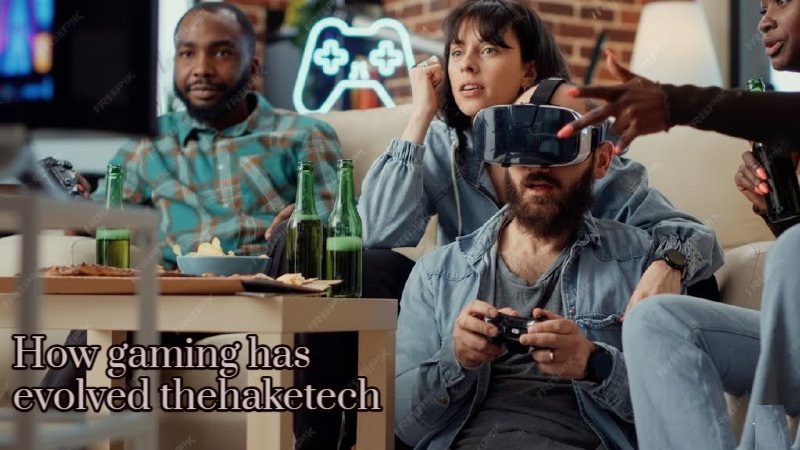
Have you ever wondered how gaming transformed from simple pixel dots to fully immersive virtual worlds? Gaming is not just technology; it’s a cultural revolution. Over the decades, it has evolved into a $200+ billion industry that connects people, inspires creativity, and pushes technological boundaries. Let’s explore this journey with TheHakeTech.
The Early Days: Simple Beginnings (1950s–1970s)
Gaming started in labs as experiments in technology. In 1958, Tennis for Two appeared on an oscilloscope, displaying nothing more than dots and lines. It may have looked simple, but it sparked a revolution.
The 1970s brought arcades into public spaces. Games like Pong and Space Invaders turned gaming into a social experience. For the first time, strangers could play together competitively, sharing excitement and building communities around games.
Key Insight:
Early gaming was about experimentation, fun, and social connection, a foundation for everything that followed.
Home Consoles: Gaming Comes Home (1980s–1990s)
The release of the Nintendo Entertainment System (NES) in 1983 changed the game forever. Titles like Super Mario Bros. and The Legend of Zelda became cultural icons. Gaming moved from arcades to living rooms, making it more personal and accessible.
My observation is that the progression systems and 8-bit to 16-bit graphics weren’t just visual upgrades; they changed how players engaged with stories and challenges. Home consoles democratized gaming, allowing almost every household to enjoy this new form of entertainment.

The 3D Revolution: Gaming Gets Cinematic (Mid-1990s–2000s)
The late 1990s introduced 3D graphics, bringing cinematic storytelling to gaming. Final Fantasy VII proved that games could deliver emotional narratives like movies. Titles like Metal Gear Solid and Super Mario 64 pushed boundaries with immersive worlds, voice acting, orchestral music, and complex gameplay.
Takeaway:
3D gaming gave video games legitimacy comparable to the film industry. It turned simple play into storytelling experiences with emotional impact.
Online Gaming: Gaming Becomes Social (2000s)
Broadband internet changed everything. World of Warcraft (2004) allowed millions of players to inhabit the same virtual world. Xbox Live and PlayStation Network made consoles social, letting players connect with friends anywhere.
Competitive games like Counter-Strike and Dota made online gaming mainstream. Online multiplayer transformed gaming from a solo hobby into a social experience where friendships and communities flourished.
Observation:
Gaming evolved from a lonely activity into a global social phenomenon.
Mobile Gaming: Games for Everyone (2008 Onwards)
The iPhone’s release in 2007 introduced gaming to millions who never considered themselves “gamers.” Games like Angry Birds, Candy Crush, and Pokémon Go made gaming accessible for all ages.
Mobile gaming also brought the freemium model: free to play, with optional in-app purchases. This strategy not only broadened audiences but also created new revenue streams for developers.
Insight:
Mobile gaming democratized gaming, making it inclusive and ubiquitous.
VR and Streaming: New Dimensions (2010s–Present)
Virtual reality (VR) and streaming platforms have taken gaming to the next level. VR devices like Oculus Rift immerse players in fully interactive worlds, making gaming a physical and emotional experience.
Streaming platforms like Twitch turned gaming into a spectator sport. Millions watch others play, while esports created professional careers for top players. VR and streaming together have made gaming social, immersive, and profitable.
Key Insight:
Technology is creating a new generation of players who engage with games in ways unimaginable decades ago.
Gaming Today: A $200+ Billion Industry (2026)
Gaming is no longer just entertainment. It plays roles in education, healthcare, training, and social connection. Here’s a snapshot of current gaming platforms:
| Gaming Platform | Market Share |
|---|---|
| Mobile Gaming | 35% |
| Console Gaming | 30% |
| PC Gaming | 25% |
| VR/AR Gaming | 5% |
| Cloud Gaming | 5% |
Observation:
The gaming landscape is diverse, and each platform serves a unique purpose in the ecosystem.
Why Gaming Matters Beyond Entertainment
Gaming offers more than fun:
Cognitive Benefits: Improves problem-solving, strategy, and multitasking.
Social Connection: Builds friendships and communities worldwide.
Economic Impact: Creates jobs for developers, designers, streamers, and esports players.
Cultural Expression: Games tell stories, convey emotions, and reflect society.
The Future of Gaming
Looking ahead, gaming is evolving in incredible ways:
Metaverse: Persistent virtual worlds where players work, play, and socialize.
AI-Generated Content: Personalized storylines and procedurally generated worlds.
Neural Interfaces: Brain-to-computer connections for immersive gameplay.
Cross-Platform Integration: Seamless experiences across console, PC, mobile, and VR.
Insight:
The future promises even more accessibility, immersion, and social interaction, making gaming central to modern life.
Frequently Asked Questions
How has gaming evolved from the 1970s to 2026?
Gaming has evolved from simple arcade dots to fully immersive VR worlds. This journey is a mix of technology, art, community, and innovation.
What is the biggest change in gaming?
The biggest change is that gaming is no longer just entertainment. It has become a social, educational, and professional opportunity.
Why does gaming evolution matter?
The evolution of gaming matters because it shapes technology, society, and culture in meaningful ways.
What’s the future of gaming?
In the future, gaming will become more immersive, more accessible, and more integrated. Technologies like the Metaverse, AI, and neural interfaces will define the next generation of gaming.
Conclusion: From Pixels to Infinite Worlds
The evolution of gaming reflects both technological innovation and human creativity. From simple dots on a screen to virtual realities and social platforms, gaming has transformed how we play, learn, and connect.
Gaming is more than entertainment; it’s a reflection of our culture, our technology, and our shared human experience. Whether you’re a casual mobile gamer or a VR enthusiast, one thing is clear: the story of gaming is still unfolding, and the future is limitless.