
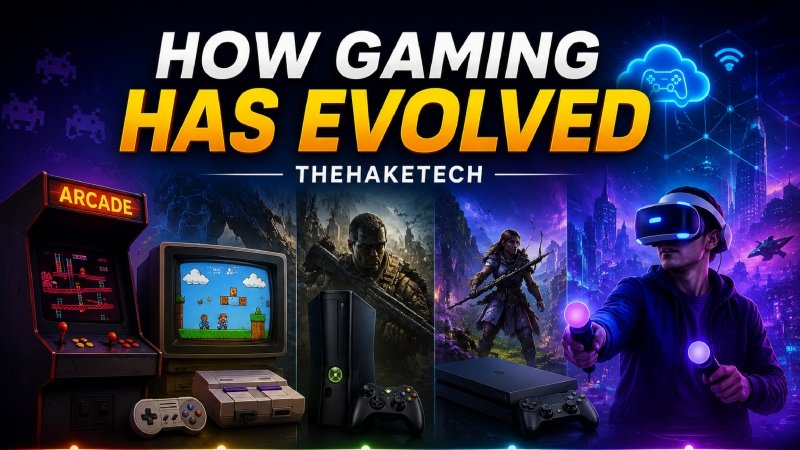
Have you ever wondered how gaming went from simple screen dots to realistic virtual worlds? Today, gaming is more than just fun. It shapes technology, culture, and even how we connect with others. Understanding how gaming has evolved thehaketech gives real insight into the innovations that changed the digital world. The journey of gaming is not only about better graphics. It also shows how creativity and engineering push boundaries together. Let’s explore how gaming has evolved thehaketech step by step, and why it matters so much today.
The Early Days of Gaming
Gaming started in a very simple way. Researchers built basic interactive programs in the 1950s and 60s. Tennis for Two (1958) ran on an oscilloscope and let two players hit a digital ball back and forth. Spacewar! (1962) introduced real-time interactive gameplay on early mainframe computers.
These games were not made for the public. However, they proved one important idea — computers could be used for entertainment, not just calculations.
These early experiments pushed technology forward. Developers needed faster systems and better visuals, which helped improve computer performance overall.
Later, in the 1970s, arcade games like Pong became popular. This was the moment gaming turned into a real industry.
The Rise of Arcades and Public Gaming
Arcades made gaming accessible to everyone. People gathered to compete, share high scores, and enjoy the experience together.
Games such as Space Invaders introduced scoring systems and difficulty levels. This created excitement and friendly competition among players.
At the same time, gaming pushed hardware companies to improve machines. Faster response time and smoother gameplay became business necessities, not just nice extras. This early period is one of the clearest examples of how gaming has evolved thehaketech continues to trace back to.
The Rise of Home Consoles
As technology improved, gaming moved from arcades into homes. Consoles like the Atari 2600, Nintendo Entertainment System, and Sega Genesis became household names.
This era changed everything. Games started to include stories, characters, and progress systems. Franchises like Super Mario, The Legend of Zelda, and Sonic the Hedgehog combined gameplay with real narrative for the first time.
Players were no longer just playing. They were experiencing adventures. Competition between companies also pushed rapid innovation. Each new console offered better graphics, sound, and memory storage.
The 3D Revolution
In the 1990s, gaming took a major leap forward with 3D graphics. Sony’s PlayStation introduced a dedicated graphics processing unit, or GPU, that could render 3D polygons in real time. Polygons are simple shapes, mostly triangles, strung together to build characters and environments.
This changed everything about how gaming has evolved thehaketech and game design together. Developers were no longer limited to flat planes. They could build worlds with height and depth. Players could walk around objects instead of just jumping over them.
Games became more realistic. Titles like Super Mario 64 and The Legend of Zelda: Ocarina of Time showed what fully explorable 3D worlds could look like.
CD-ROM technology arrived around the same time. Game cartridges maxed out at roughly 64 megabytes. CDs held over 600 megabytes — ten times more space. This allowed developers to add voice acting, orchestral soundtracks, and full-motion video. Final Fantasy VII, Metal Gear Solid, and Resident Evil all used this extra space for cinematic storytelling that felt impossible just years earlier.
The Internet Changed Everything
The 2000s introduced widespread online gaming. Suddenly, players could connect from anywhere in the world.
Games like World of Warcraft and Counter-Strike created massive online communities. EverQuest and World of Warcraft also introduced persistent worlds — game spaces that kept running whether a player was logged in or not. This shift turned gaming into a true social experience.
It also led to esports and streaming. Platforms like Twitch and YouTube Gaming allowed players to share gameplay with millions of viewers. Gaming was no longer just playing it became watching and competing too. This online shift is a major part of how gaming has evolved thehaketech keeps tracking it through industry reports.
Mobile Gaming for Everyone
Smartphones made gaming accessible to nearly everyone. Simple games like Candy Crush Saga and Angry Birds reached millions of new players who never owned a console.
Mobile gaming introduced two big changes:
- Easy access for everyone, with no expensive equipment needed
- New earning models, like in-app purchases and the freemium system
It also pushed smartphone companies to improve performance, battery life, and graphics quality across the board.
Virtual Reality and Immersion
Gaming is no longer limited to flat screens. Virtual reality and augmented reality let players step inside the game itself. Devices like the Oculus Rift create fully immersive experiences with head and hand tracking.
Games such as Pokémon GO blend digital elements with real-world surroundings. These same innovations now help other industries too, including education, healthcare, and professional training simulations.
The Role of Artificial Intelligence
Artificial intelligence has made games smarter. Today, non-player characters react to player actions in realistic ways. Games adjust difficulty automatically based on individual skill level.
AI in gaming has also influenced real-world technology. It plays a role in automation, recommendation systems, matchmaking, and even self-driving vehicle systems. This crossover is one of the most overlooked parts of how gaming has evolved thehaketech experts continue to study it closely.
Cloud Gaming and the Future of Access
Cloud gaming is changing how people play. Services like NVIDIA GeForce Now, Xbox Cloud Gaming, and PlayStation Now let users stream games without expensive local hardware.
By 2026, cloud gaming will have become far more stable and widely available. It supports cross-device play, letting users switch between phone, tablet, and PC easily. This makes gaming more affordable and accessible than ever before. These same low-latency improvements also benefit video conferencing and remote work technology.
Gaming as a Social and Cultural Force
Gaming is no longer just entertainment. It has become a global culture. Players connect daily through online platforms, communities, and live streams.
Gaming now influences music, fashion, storytelling, and everyday social interaction. It brings people together across different countries and backgrounds, often forming friendships that last for years.
The Future of Gaming
The future of gaming looks even more exciting. New trends shaping 2026 and beyond include:
- AI-driven, personalized game design that adjusts story paths and challenges in real time
- Metaverse experiences and persistent shared digital worlds
- Blockchain and NFTs introducing new ownership and monetization models
- Sustainable game development, including eco-conscious design and reduced energy use
- Advanced VR systems with sharper realism and lower cost
These innovations will keep making gaming more interactive and personal than ever before.
Conclusion
Gaming has come a long way from simple pixels on a screen. It has shaped technology, built global communities, and created entirely new career paths. Looking closely at how gaming has evolved thehaketech trends will likely keep shaping over the next decade shows that this industry never really stops moving. What started as a small experiment is now a powerful force in the modern world, and the journey is still not over.
FAQs
1. What does “how gaming has evolved thehaketech” actually mean?
It refers to the full journey of video games, from simple early experiments to today’s immersive digital experiences, and how that growth shaped wider technology.
2. What technologies did gaming help advance?
Gaming pushed forward GPUs, faster processors, cloud computing, AI systems, and motion-tracking hardware — tools now used far beyond entertainment.
3. When did gaming become mainstream?
Gaming became mainstream in the 1980s through home consoles, then expanded further with PCs, the internet, and smartphones.
4. How is AI changing modern games?
AI now powers smarter non-player characters, dynamic difficulty, matchmaking, and even procedural world generation.
5. What’s next for gaming technology?
Expect more AI-personalized worlds, expanded cloud gaming, blockchain-based ownership models, and more affordable VR systems.