
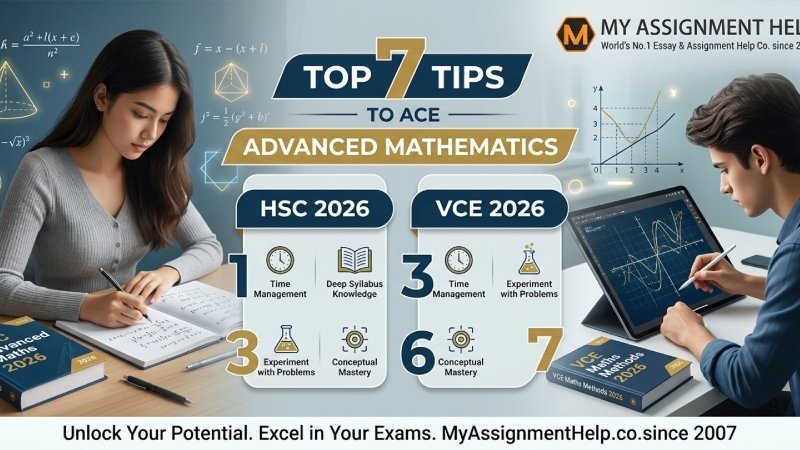
For Year 12 students across New South Wales and Victoria, the Higher School Certificate (HSC) and Victorian Certificate of Education (VCE) represent the culmination of years of academic rigour. In 2026, the landscape of Advanced Mathematics is more competitive than ever. With shifting scaling patterns and an increased focus on multi-stage problem solving, “just knowing the formulas” is no longer enough to secure a Band 6 or a study score of 40+.
Success in Advanced Mathematics requires a blend of tactical precision, conceptual depth, and psychological resilience. To help you navigate the complexities of calculus, statistical analysis, and functions, we’ve compiled the definitive guide to mastering your 2026 exams.
The 2026 Mathematical Landscape: What’s Changed?
Recent data from the Victorian Curriculum and Assessment Authority (VCAA) and the NSW Education Standards Authority (NESA) indicate a shift toward “modelling” and “unfamiliar context” questions. In 2025, approximately 15-20% of exam marks were allocated to questions that required students to apply mathematical concepts to real-world scenarios.
If you find yourself struggling to bridge the gap between theory and application, seeking professional Math Assignment Help can provide the structured clarity needed to master these complex modules. Early intervention is key; according to the Australian Bureau of Statistics (ABS) education trends, students who engage in consistent, guided practice 6 months before exams see a marked improvement in their internal assessment ranks.
Top 7 Tips to Ace Your 2026 Mathematics Exams
Master the Art of the Reference Sheet
In both the HSC and VCE, you are provided with formula sheets. However, the top-performing 5% of students don’t rely on them during the exam—they use them as a safety net.
- The Strategy: Memorise the derivations, not just the formulas. If you understand how the derivative of $\sin(x)$ becomes $\cos(x)$ via first principles, you are less likely to freeze if a question is phrased unusually.
Prioritise “High-Value” Topics: Calculus and Statistics
In the 2026 syllabus, Calculus (Differential and Integral) and Statistical Analysis carry the highest weightings.
- HSC Focus: Focus on the “Mathematics Advanced” applications of finance and motion.
- VCE Focus: Ensure your CAS (Computer Algebra System) skills are fluid for Probability and Calculus.
The “Reverse Engineering” Technique
When tackling past papers, don’t just check the final answer. Study the marking guidelines.
- Data Point: NESA reports frequently highlight that students lose up to 10% of potential marks not due to incorrect answers, but due to “insufficient working” or “lack of mathematical reasoning.”
Optimise Your Technology Workflow
Whether you are using a TI-Nspire or a Casio ClassPad, your calculator should be an extension of your hand. In 2026, VCE Further and Specialist Maths exams will likely include more questions that test your ability to interpret CAS output rather than just computing it.
Build a “Mistake Journal”
Every time you get a question wrong in a trial exam, don’t just fix it and move on. Record the type of error. Was it a calculation error, a reading error, or a conceptual gap? Categorising your mistakes allows you to identify patterns. If you find yourself consistently failing at integration by parts, it’s time to say “do my assignment” to a professional service that can break down the logic step-by-step for you.
Time Management: The 1-Mark-Per-Minute Rule
The 2026 exams are designed to be time-pressured. A common pitfall is spending 10 minutes on a 3-mark question at the start of the paper, leaving no time for the difficult 5-8 mark questions at the end.
- Tip: Practice “sprint sessions” where you complete the first 10 multiple-choice questions in exactly 10 minutes.
Leverage E-E-A-T in Your Study Material
Ensure the resources you are using are written by experts who understand the Australian curriculum. Avoid generic international textbooks that don’t align with the specific nuances of the NESA or VCAA syllabus.
Key Takeaways for 2026 Candidates
- Conceptual Depth > Rote Learning: Understand the why behind the theorem.
- Regional Specifics: VCE students must master CAS; HSC students must master rigorous manual proofs.
- Data-Driven Review: Use past marking reports to see where the state average dropped.
- Consistency: 30 minutes of math daily is more effective than a 6-hour “cram” session.
Frequently Asked Questions (FAQ)
Q: Is the 2026 HSC Math exam harder than previous years?
A: While the difficulty of the content remains consistent with the syllabus, there is a trend toward more “unstructured” questions that require multiple steps of logic, making it feel more challenging for those used to “plug-and-play” math.
Q: Should I focus more on Year 11 or Year 12 content?
A: Year 12 content builds directly on Year 11. In the HSC, up to 30% of the exam can be derived from Year 11 preliminary topics. Do not neglect your foundations.
Q: How can I improve my speed in the VCE Math Methods exam?
A: Master your “Bound Reference.” Having an indexed, easy-to-navigate reference book for Exam 2 can save you vital minutes when looking up complex transformations or distributions.
Q: Are AI-generated study notes reliable?
A: AI can be a great tool for summarising, but it often hallucinates mathematical proofs. Always cross-reference AI notes with official NESA/VCAA textbooks to ensure accuracy and E-E-A-T compliance.
References and Data Sources
- NESA (2025): Mathematics Advanced Marking Feedback and Exam Reports.
- VCAA (2025): Mathematical Methods: Examination Specifications and Sample Material.
- Australian Journal of Education: Impact of Consistent Practice on High-Stakes STEM Examinations.
- Tertiary Admissions Centres (UAC/VTAC): Scaling Reports for Category A Mathematics Subjects.
About the Author: Aidan Thorne
Aidan Thorne is a Senior Academic Consultant at MyAssignmentHelp. With a Master’s degree in Mathematics from the University of Melbourne and over 8 years of experience in the Australian tutoring sector, Aidan specialises in helping Year 12 students navigate the specific rigours of the HSC and VCE frameworks. His focus is on making high-level calculus and statistical theory accessible to students of all levels, ensuring they achieve their target ATAR goals.