
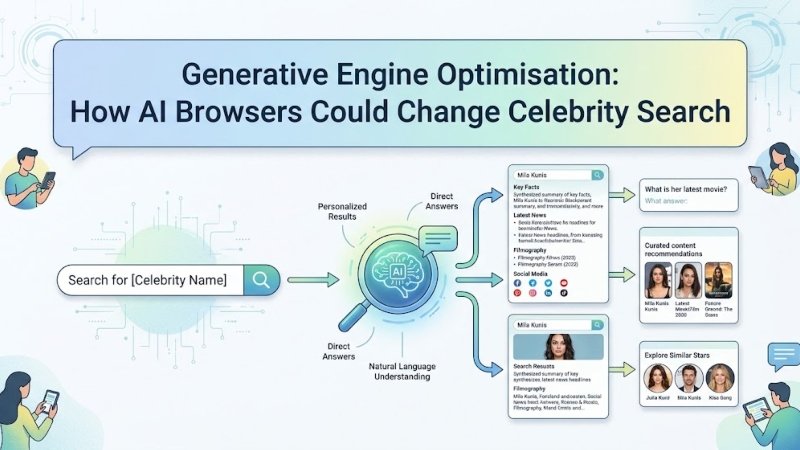
When fans look up a celebrity, they may want more than a list of links. They might be searching for the story behind a casting decision, a recent interview, or the difference between two people with similar names. As AI features enter browsers and search tools, the way those answers are found and presented is changing. Generative Engine Optimisation, often shortened to GEO, is one approach publishers are considering to help their accurate, useful content appear in AI-generated responses.
The shift does not mean traditional search has disappeared. Google Chrome remains a familiar way to access the web, while newer browser experiences and AI assistants experiment with summarizing information and answering questions directly. For publishers covering celebrities, entertainment, technology, or culture, the practical challenge is to make articles clear and trustworthy wherever readers encounter them.
What Is Generative Engine Optimisation?
Generative Engine Optimisation is the practice of making content easier for AI systems to understand, evaluate, and potentially use when producing an answer. Traditional search engine optimisation often focuses on helping a page rank for a query and earn a click. GEO also considers what happens when a system summarizes several sources before the reader visits any of them.
That distinction matters. A reader asking “Which films made this actor famous?” may see a short answer assembled from multiple pages. A well-organized article can help clarify the timeline, explain the role, and distinguish confirmed information from speculation. GEO is not a guarantee that an AI tool will quote a page, nor does it replace accurate reporting. It is a way to make useful information more understandable to both people and machines.
Why Are AI Browsers Part of the Conversation?
Browsers have traditionally been the doorway to websites, while search engines have helped people find them. AI assistants are beginning to blur that boundary by offering summaries, conversational search, and other ways to explore information. The precise features and capabilities of each product can change, so it is wise to view new tools as evolving options rather than assume they will immediately replace established browsers.
The debate over whether ChatGPT Atlas and Comet could challenge Chrome is part of this wider change. This comparison of Atlas, Comet, and Chrome considers the competition between AI-centered browsing and the browser habits people already know. For publishers, the key question is not only which browser becomes popular, but how readers discover information across different interfaces.
How Celebrity Websites Can Prepare
Celebrity coverage often involves fast-moving stories, familiar names, and details that can easily be misunderstood. A few practical habits can make an article clearer for readers and more useful to systems that interpret web content:
- Answer the main question early. If an article explains whether two stars worked together, state the verified connection near the beginning instead of making readers search through several sections.
- Use specific headings. Headings such as “When Did They Work Together?” or “What Is Confirmed?” show how each section contributes to the topic.
- Separate fact from interpretation. Clearly distinguish official credits and public statements from rumors, fan theories, or an author’s analysis.
- Provide useful context. Dates, roles, project names, and explanations of industry terms can prevent a short answer from becoming misleading.
- Update articles when facts change. A new project announcement or correction may affect an older story. Review important pages instead of letting outdated details stand.
These are also good editorial practices for human readers. A celebrity profile should be easy to scan, but concise writing should not remove important qualifications. If a relationship is only an indirect professional connection, say so rather than turning an association into a claim of personal friendship.
Content Quality Still Matters More Than Tricks
There is no reliable shortcut that forces an AI assistant to feature a particular website. Repeating a target phrase, adding excessive headings, or publishing thin pages can make an article less helpful. A stronger foundation is original reporting or carefully checked information, clear explanations, and a structure that matches what the reader came to learn.
It is also useful to think beyond text. A recognizable website, readable layout, and well-chosen images can help people understand and remember a story. For an editorial team updating its visual identity, a professional graphic designer may help create article illustrations, social media templates, or consistent page elements. Osdire’s guide on hiring a graphic designer in 2026 offers a starting point for thinking through the work and choosing the right fit.
What GEO Cannot Do
GEO cannot promise visibility, control how a platform summarizes a page, or replace editorial judgment. AI-generated answers may omit context or make mistakes, and platforms can change how they select and display sources. Publishers should therefore monitor referral patterns and reader feedback where possible, but avoid rebuilding an entire site around one new product.
For readers, the same caution applies: an AI summary is a useful starting point, not always the final word. When a claim concerns a celebrity’s career, personal life, or professional credits, check whether the answer points to dependable evidence and whether the article gives the necessary context.
Conclusion
Generative Engine Optimisation reflects a broader change in how people may find information as browsers and AI tools develop. It is not a replacement for traditional search or careful journalism. Celebrity and culture websites can prepare by answering questions directly, organizing articles clearly, checking claims, and maintaining a useful experience for readers. The platforms may change, but accurate, well-explained stories remain the most durable reason for someone to visit a site.