
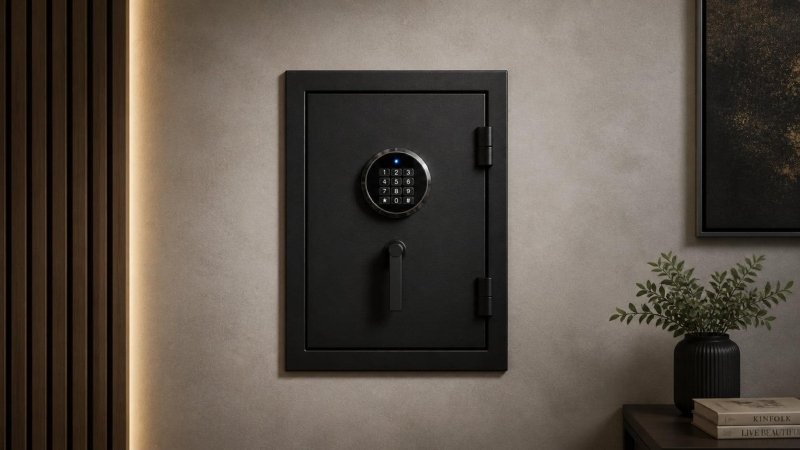
You’ve probably seen it in movies — a painting slides aside to reveal a hidden safe tucked neatly into the wall. It looks sleek, secretive, and satisfying. But beyond the Hollywood drama, wall safes are a genuinely practical security solution that thousands of homeowners quietly rely on every day.
So what exactly is a wall safe? How does the whole thing work, and most importantly, should you actually get one?
Let’s break it down.
What Is a Wall Safe?
A wall safe is a compact, steel-constructed security unit designed to fit flush inside the cavity of a standard interior wall, typically between two vertical studs. Unlike bulky floor safes or freestanding cabinets, a wall safe sits recessed into the wall itself, leaving only its door visible from the outside.
That door can then be hidden behind a framed picture, a mirror, a shelf, or even left inside a wardrobe. The result is a storage solution that is both secure and effectively invisible to anyone who doesn’t already know it’s there.
Wall safes are built to store the kinds of valuables that people genuinely worry about losing: cash, passports, jewellery, insurance documents, USB drives, small firearms, and anything else that would be costly or devastating to replace.
How Does a Wall Safe Actually Work?
The mechanics are more straightforward than most people expect.
Installation involves cutting a hole in the drywall between two wall studs, sliding the safe body into that cavity, and bolting it securely to the studs from the inside. Most modern wall safes come with pre-drilled mounting holes and clear installation instructions many homeowners handle it themselves in under two hours.
The locking system is where things get interesting. Wall safes are available with several different access mechanisms, each with its own trade-offs:
- Electronic keypad — You enter a PIN code to unlock. Fast, convenient, and easy to change if needed. Requires batteries, which need occasional replacement.
- Biometric (fingerprint) — Scans your fingerprint for entry. Extremely quick access, ideal for emergencies. Premium models can store up to 30+ fingerprints for multiple users.
- Combination dial — The traditional mechanical option. No batteries required, extremely reliable over the long term, though slightly slower to open.
- Key lock — Simple and dependable, but carries the risk of lost or misplaced keys.
Once locked, steel locking bolts extend from the door into the surrounding frame, making it highly resistant to prying. Higher-quality models also feature re-locker pins and hardened internal mechanisms that engage automatically if the safe is tampered with, making forced entry significantly harder even with tools.
Concealment is the final layer of how a wall safe “works” as a security tool. A safe that’s never discovered is a safe that’s never attacked. Positioning it behind artwork in a bedroom, deep inside a wardrobe, or in a low-traffic room adds real-world protection that raw steel thickness alone cannot provide.
Is a Wall Safe Actually Worth It?
This is the honest question, and the answer is: for most households, yes, with the right expectations.
Here’s what a wall safe does exceptionally well:
It removes the grab-and-go risk. Most home burglaries are fast, under ten minutes. A thief scanning a room for quick valuables is far more likely to grab what’s visible than spend time searching for a hidden safe they may not even find. Concealment alone reduces your risk considerably.
It organizes what matters most. There’s genuine peace of mind in knowing exactly where your passports, birth certificates, spare cash, and spare cards are in one secure, fireproof location.
It doesn’t take up living space. Unlike a floor safe or a gun cabinet, a wall safe disappears into the architecture of your home. It works with your space rather than against it.
That said, wall safes do have real limitations worth knowing. They offer limited fire protection; the shallow depth of a wall cavity doesn’t allow for thick insulation layers. And if someone does discover one that’s anchored only to lightweight timber studs, a determined intruder with the right tools can eventually remove it.
The solution? Choose a model with a genuine UL or RSC security rating, not just vague marketing language about “heavy-duty steel.” Reputable retailers like Safes Australia offer certified models with independently tested ratings, which is the only meaningful way to know what you’re actually buying.
The Bottom Line
A wall safe isn’t a perfect security solution; nothing is. But for everyday protection of your most important valuables, it strikes an excellent balance between accessibility, concealment, and genuine resistance to theft.
It’s discreet enough to go unnoticed. Strong enough to deter most threats. And practical enough that you’ll actually use it.
And at the end of the day, a security measure you actually use is always worth more than a perfect one you don’t.